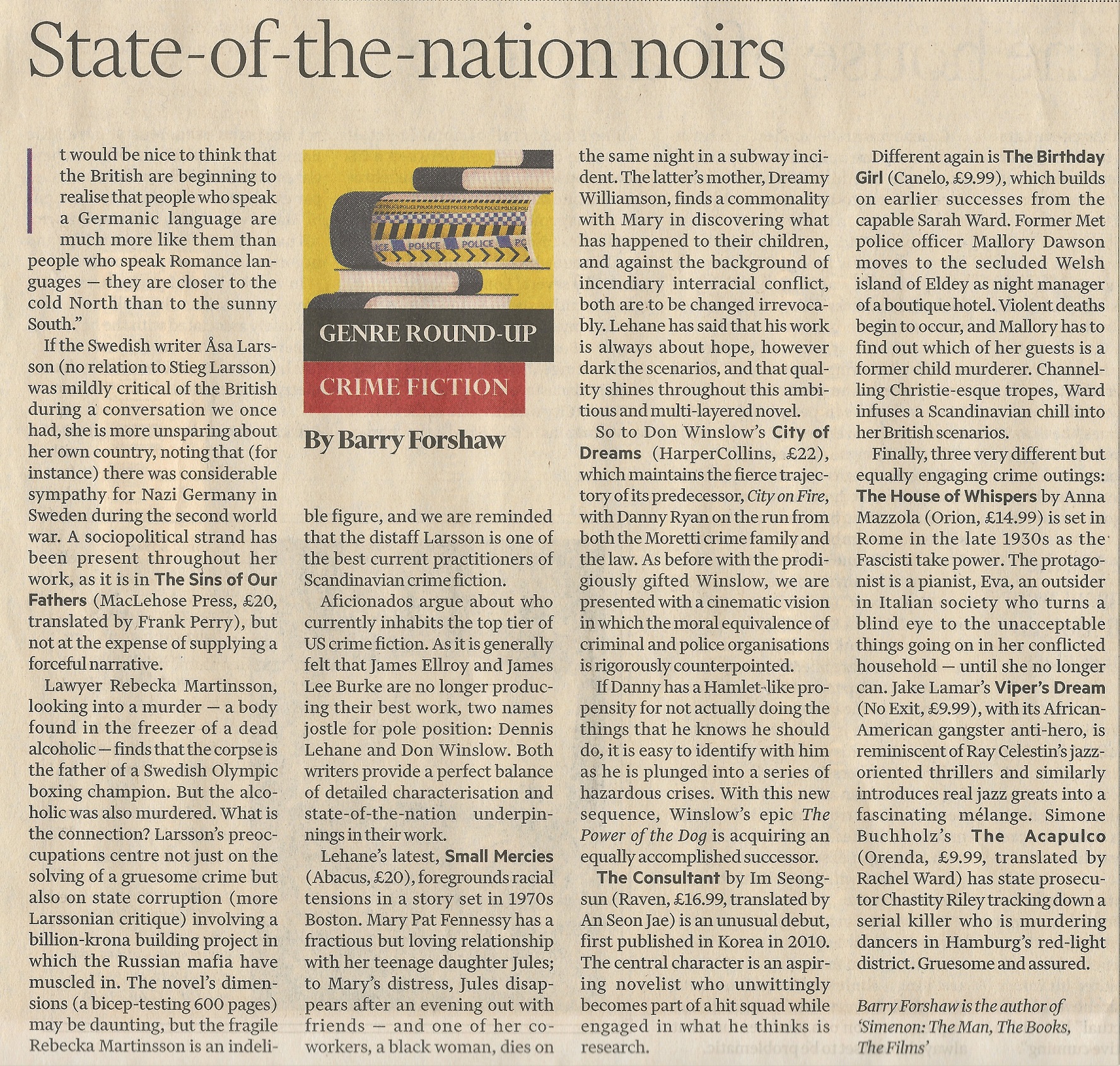
Managed to get a nicely eclectic mix in the latest FT crime column: Åsa Larsson, Dennis Lehane, Im Seong-Sun, Don Winslow, Sarah Ward, Simone Buchholz, Anna Mazzola, Jake Lamar…
“It would be nice to think that the British are beginning to realise that people who speak a Germanic language are much more like them than people who speak Romance languages — they are closer to the cold North than to the sunny South.”
If the Swedish writer Åsa Larsson (no relation to Stieg Larsson) was mildly critical of the British in a conversation we had, she is more unsparing about her own country, noting that (for instance) there was considerable sympathy for Nazi Germany in Sweden during the second world war. A sociopolitical strand has been present throughout her work, as it is in The Sins of Our Fathers (MacLehose Press, £20, translated by Frank Perry) but not at the expense of supplying a forceful narrative.
Lawyer Rebecka Martinsson, looking into a murder — a body found in the freezer of a dead alcoholic — finds that the corpse is the father of a Swedish Olympic boxing champion. But the alcoholic was also murdered. What is the connection? Larsson’s preoccupations centre not just on the solving of a gruesome crime but also on state corruption (more Larssonian critique) involving a billion-kroner building project in which the Russian mafia have muscled in. The novel’s dimensions (a bicep-testing 600 pages) may be daunting, but the fragile Rebecka Martinsson is an indelible figure, and we are reminded that the distaff Larsson is one of the best current practitioners of Scandinavian crime fiction.
Aficionados argue about who currently inhabits the top tier of American crime fiction. As it is generally felt that James Ellroy and James Lee Burke are no longer producing their best work, two names jostle for pole position: Dennis Lehane and Don Winslow. Both writers provide a perfect balance of detailed characterisation and state-of-the-nation underpinnings in their work.
Lehane’s latest, Small Mercies (Abacus, £20), foregrounds racial tensions in a story set in 1970s Boston. Mary Pat Fennessy has a fractious but loving relationship with her teenage daughter Jules; to Mary’s distress, Jules disappears after an evening out with friends — and one of her co-workers, a black woman, dies on the same night in a subway incident. The latter’s mother, Dreamy Williamson, finds a commonality with Mary in discovering what has happened to their children, and against the background of incendiary interracial conflict, both are to be changed irrevocably. Lehane has said that his work is always about hope, however dark the scenarios, and that quality shines throughout this ambitious and multi-layered novel.
So to Don Winslow’s City of Dreams (HarperCollins, £22), which maintains the fierce trajectory of its predecessor, City on Fire, with Danny Ryan on the run from both the Moretti crime family and the law. As before with the prodigiously gifted Winslow, we are presented with a cinematic vision in which the moral equivalence of criminal and police organisations is rigorously counterpointed. If Danny has a Hamlet-like propensity for not actually doing the things that he knows he should do, it is easy to identify with him as he is plunged into a series of hazardous crises. With this new sequence, Winslow’s epic The Power of the Dog is acquiring an equally accomplished successor.
The Consultant by Im Seong-sun (Raven, £16.99, translated by An Seon Jae) is an unusual debut first published in Korea in 2010. The central character is an aspiring novelist who unwittingly becomes part of a hit squad while engaged in what he thinks is research.
Different again is The Birthday Girl (Canelo, £9.99) which builds on earlier successes from the capable Sarah Ward. Former Met police officer Mallory Dawson moves to the secluded Welsh island of Eldey as night manager of a boutique hotel. Violent deaths begin to occur, and Mallory has to find out which of her guests is a former child murderer. Channelling Christie-esque tropes and using multiple points of view, Ward, like Ann Cleeves, infuses a Scandinavian chill into her British scenarios.
Finally, three very different but equally engaging crime outings: The House of Whispers by Anna Mazzola (Orion, £14.99) is set in Rome in the late 1930s as the Fascisti take power. The protagonist is a pianist, Eva, an outsider in Italian society who turns a blind eye to the unacceptable things going on in her conflicted household – until she no longer can. Jake Lamar’s Viper’s Dream (No Exit, £9.99), with its African-American gangster anti-hero, is reminiscent of Ray Celestin’s jazz-oriented thrillers and similarly introduces real jazz greats into a fascinating mélange. Simone Buchholz’s The Acapulco (Orenda, £9.99, translated by Rachel Ward) has state prosecutor Chastity Riley tracking down a serial killer who is murdering dancers from a club in Hamburg’s red-light district. Gruesome and assured, Buchholz’s work remains as persuasive as ever.