The Lark Ascending by Richard King
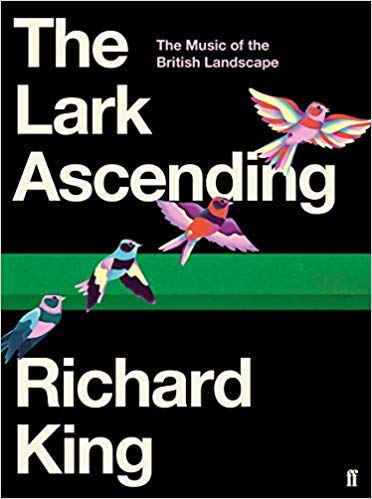
Vaughan Williams’ exquisite orchestral tone poem The Lark Ascending has become comfortably Britain’s most popular piece of classical music, seeing off a variety of once better-known works. This is notably ironic, given that the composer was for some time almost a prophet without honour in his own country, but his pre-eminence as arguably Britain’s greatest symphonist is no longer such a radical thought as it once might have seemed to be. But is the composer and his music emblematic of this country? That’s part of the premise of Richard King’s fascinating and cogently argued new book which takes the composer of his music as a starting point for a discussion of notions of Englishness.
Cultural historian Richard King is the author of the critically-acclaimed author of How Soon Is Now? and his new book is a history of the British countryside told through the relationship between music and landscape and a lyrical exploration of how Britain’s identity was shaped throughout the Twentieth Century by the urge to reimagine the country’s wild places. From the psychologically altered English landscape Vaughan Williams and his generation encountered as they returned after the armistice, to the agrarian revivalists and of the 1930s; from the ‘Back to the Land’ movement of the 1960s to the changing landscape of the 1980s, which witnessed the Women’s Peace Camp at Greenham Common and New Age Travellers congregating every year at Stonehenge, rural Britain was a source of great social energy and a place of dramatic change.
Music was an inspiration and complement to these new interpretations of a British pastoral tradition, from the song written to commemorate the mass trespass of Kinder Scout in 1932, to the moment, sixty years later, when the sound systems at the country’s largest ever illegal rave, held at Castlemorton Common, finally ran out of charge.
Through a series of ‘headphone walks’ and reflective interviews with musicians, filmmakers, ruralists and witnesses Richard King listens closely to Britain’s rural landscapes and the compositions inspired by their beauty and drama. His journey takes him from the west coast of Wales to the Lothian Hills, from the Thames Estuary to the Suffolk shoreline – and from Vaughan Williams to Brian Eno, from Penguin Cafe Orchestra to the Raincoats, from Kate Bush to Boards of Canada, ‘The Sinking of the Titanic’ to Greenham Common …
His unique and intimate history of a nation celebrates the British countryside as a living, working, and occasionally rancorous environment – rather than an unaffected idyll – that forged a nation’s musical personality and provided a space in which life could be experienced on its own terms and its fullest, under open skies, far away from the gaze of authority.
The Lark Ascending by Richard King is published by Faber
http://www.cdchoice.co.uk/