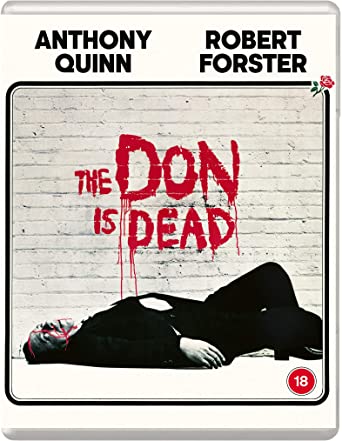
THE DON IS DEAD, Richard Fleischer, director/Eureka Entertainment Blu-ray Over the years, the reputation of Richard Fleischer’s taut and fast-moving The Narrow Margin (1952) has grown – despite its lack of star wattage; there is a rare lead from the harsh-voiced Charles McGraw and a typically memorable hard-bitten floozy from Marie Windsor, although neither is in the Burt Lancaster or Ava Gardner box-office league. In fact, it is Fleischer’s adroit handling of his lean material that make this one so special. The film was regarded for many years as an unpretentious studio project that was expected to turn a profit but also to be quickly forgotten. The latter fate, however, was not in the cards for The Narrow Margin. Decades later, Fleischer’s Mafia movie, The Don Is Dead (1973 – for which I’ve written a booklet essay on Fleischer’s career), makes no attempt to emulate The Godfather (the plot’s succession issues apart), following as it does the script by Marvin H. Albert, who adapted his own novel along with the writers Michael Butler and Christopher Trumbo. In the wake of – and at the same time as – the Coppola film, high-profile mob movies included Dino De Laurentiis’s production The Valachi Papers (directed by Terence Young in 1972 — see below), which was accompanied by publicity suggesting that the actual Mafia had supervised the production. Among other entries in the genre were Honor Thy Father (Paul Wendkos), The Big Family (Tonino Ricci), and even a blaxploitation movie, The Godfather of Harlem (Larry Cohen; all three came out in 1973). Fleischer was well aware that he had to pull all the stops out to make his own entry rise above the competition. Apart from his own directorial skills, Fleischer had four aces up his sleeve where his film was concerned: first, the always reliable veteran Anthony Quinn, one of the best character actors in American film, as Don Angelo Di Morra; second, the casting of two ruthless mobsters with drug connections. As Tony and Vince Fargo, Fleischer employed two under-regarded actors who could always be relied upon to turn in strongly characterised work: Frederic Forrest and Al Lettieri. Another factor that Fleischer knew would be a sterling asset for his film was his composer, Jerry Goldsmith. Unlike many other perfectly efficient composers whose musical language changed little from film to film, Goldsmith always tailored his scores to the particular demands of the movie he was working on – very much the case here, with his dissonant, threat-laden instrumental writing. The working out of the plot (in which the Fargo brothers have a decisive split with the organisation when Don Angelo is elected as the new Mafia capo) is handled with typical efficiency by the director. Fleischer, never afraid to tackle violence in his films, here gives the explosive ordnance free rein – the battle for control of the mob is a notably bullet-ridden affair.
THE VALACHI PAPERS & THE VALDEZ HORSES, Terence Young & Jon Sturges, directors/Powerhouse Indicator Blu-rays In the modern public imagination, the image of the actor Charles Bronson may now be ineluctably set as the stonefaced, unresponsive killing machine that was inaugurated with the first Death Wish film directed by Michael Winner and which the actor parleyed into a long-running series of clones of that movie. Which is a shame, as it should be remembered that Bronson was, in fact, an actor of range and talent as was evident in the earlier films he made for the director John Sturges such as The Magnificent Seven and The Great Escape. His last encounter with that director, The Valdez Horses (also known as Chino), was a troubled project in which director and star notably fell out – Bronson was now the number one box office draw when the film was made, and behaved in high-handed fashion, but both men are at least able to recapture the subtleties of their earlier work in this tale of a mixed-race horse breeder up against considerable odds. Terence Young’s Mafia thriller The Valachi Papers, based on a real-life story of a mobster turning against his erstwhile associates, is also distinctly mixed in its levels of achievement, but has much to admire both for fans of crime movies and those who remember when Bronson was prepared to take on more challenging parts. Both transfers are exemplary.
INNER SANCTUM MYSTERIES, Various directors, Eureka Entertainment Blu-ray Great will be the rejoicing that the availability of this elusive series of films will inspire in aficionados of the macabre — and although some of the items on offer in this handsome set have been fitfully available, it’s particularly welcome to have them all together in splendid new transfers. Those aficionados of the macabre mentioned in the previous sentence may be surprised to hear that the series turns out to be not horror-based (despite its creepy introduction with a distorted head within a crystal ball) but crime oriented pieces; these are all essentially crime mysteries with the occasional horror element. They are, however, full of performances by reliable actors of the day, and Lon Chaney Jr. is always watchable – even though, curiously, he is cast against type in every episode as a professional man or academic, some distance from the blue-collar persona which is the actor’s default fiefdom. The films are: Calling Dr. Death (dir. Reginald Le Borg, 1943), Weird Woman (dir. Reginald Le Borg, 1944), Dead Man’s Eyes (dir. Reginald Le Borg, 1944), The Frozen Ghost (dir. Harold Young, 1945) and Pillow of Death (dir. Wallace Fox, 1945). Tempting extras include Kim Newman on The Inner Sanctum Mysteries, a new interview with the journalist and film critic, and a collector’s booklet featuring new writing on the series by Craig Ian Mann.